
“Și piatra prinde mușchi dacă șede mult într-un loc” ― Ion Creangă, Povestea lui Stan Păţitul
A brief timeline:
- 1837 - Born in Humulești, Principality of Moldavia (now part of Târgu Neamț,Romania.
- 1849 - Creangă was pulled out by his financially struggling father, spent the following period working in wool-spinning, and became known by the occupational nickname Torcălău ("Spinster").
- 1860 - Creangă was ordained in December of the same year, assigned to the position of deacon in Holy Trinity Church

Ion Creangă was born in Humulești in the Principality of Moldavia, a former village which has since been incorporated into Târgu Neamț city, the son of Orthodox trader Ștefan sin Petre Ciubotariul and his wife Smaranda. His native area, bordering on heavily forested areas, was in the Eastern Carpathian foothills, and included into what was then the Principality of Moldavia.
The surrounding region's population preserved an archaic way of life, dominated by shepherding, textile manufacturing and related occupations, and noted for preserving the older forms of local folklore. Another characteristic of the area, which left an impression on Creangă's family history, was related to the practice of transhumance and the links between ethnic Romanian communities on both sides of the mountains, in Moldavia and Transylvania: on his maternal side, the writer descended from Maramureș-born peasants, while, according to literary historian George Călinescu, his father's origin may have been further southwest, in Transylvania-proper.
- 1864 - He had been attending Iași's Trei Ierarhi Monastery normal school (Trisfetite or Trei Sfetite), where he first met the young cultural figure Titu Maiorescu.
- 1866 - Having briefly served at Iași's Pantelimon Church, he was welcomed by hegumen Isaia Vicol Dioclias into the service of Golia Monastery.
- 1874 - Soon after taking over Minister of Education in the Conservative Party cabinet of Lascăr Catargiu, his friend Maiorescu granted Creangă the position of schoolteacher in the Iași area of Păcurari.
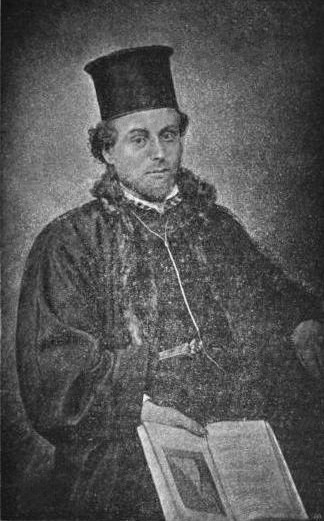
In 1860, Creangă enlisted at the Faculty of Theology, part of the newly founded University of Iași, and, in December 1860, fathered a son, Constantin. His life still lacked in stability, and he decided to move out of Grigoriu's supervision and into Bărboi Church, before his position as deacon was cut out of the budget and his belongings were evicted out of his temporary lodging in 1864. He contemplated leaving the city, and even officially requested a new assignment in the more remote Bolgrad.
Since January 1864, when the Faculty of Theology had been closed down, he had been attending Iași's Trei Ierarhi Monastery normal school (Trisfetite or Trei Sfetite), where he first met the young cultural figure Titu Maiorescu, who served as his teacher and supervisor, and whence he graduated as the first in his class (June 1865). Embittered by his own experience with the education system, Creangă became an enthusiastic promoter of Maiorescu's ideas on education reform and modernization, and in particular of the new methods of teaching reading and writing.“Nu-i vorbă, că tot are și ea o coastă de drac; dar, trăind și nemurind, i-om scoate-o noi și pe-aceea” ― Ion Creangă, Povestea lui Stan Păţitul
For more information visit
wikipedia page